
The greenhouse effect
5.2.1 Draw and label a diagram of the carbon cycle to show the processes involved.
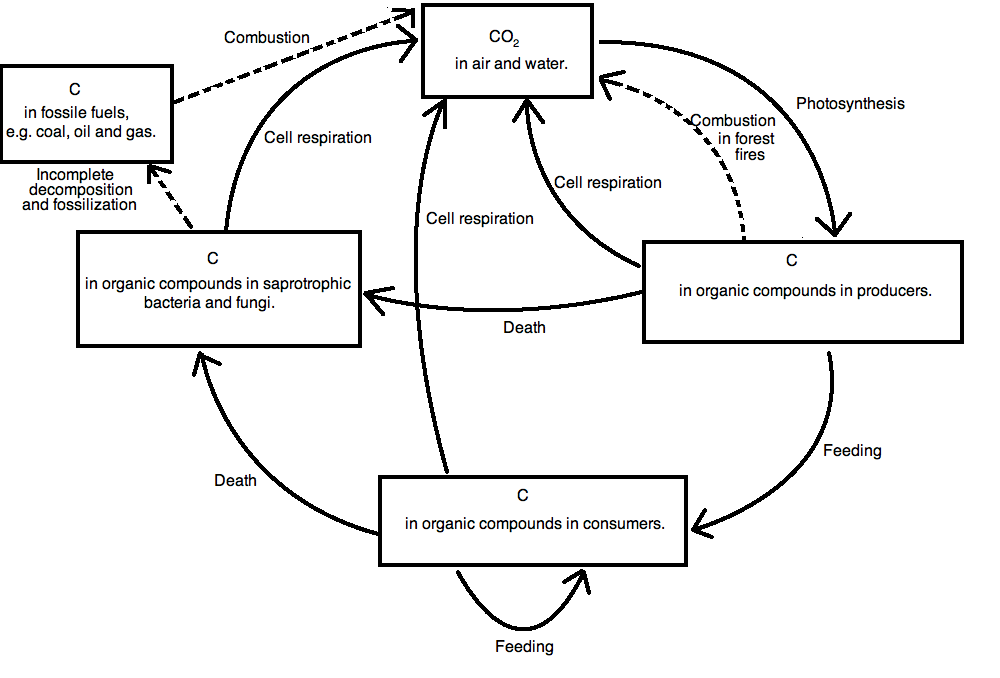
Figure 5.2.1 - The carbon cycle
5.2.2 Analyse the changes in concentration of atmospheric carbon dioxide using historical records.
See video (coming soon)
5.2.3 Explain the relationship between rises in concentrations of atmospheric carbon dioxide, methane and oxides of nitrogen and the enhanced greenhouse effect.
The earths mean average temperature is regulated by a steady equilibrium which exists between the energy reaching the earth from the sun and the energy reflected by the earth back into space. The incoming radiation is short wave ultraviolet and visible radiation. Some of the radiation will be absorbed by the atmosphere and some of it will be reflected back from the earths surface into space. The radiation that is reflected back into space is infrared radiation which has a longer wavelength. Green house gases such as carbon dioxide, methane, and oxides of nitrogen tend to absorb some of the reflected infrared radiation and re-reflect it back towards the earth. This is what causes the greenhouse effect and it results in an increase in average mean temperature on earth. It is a natural phenomenon. However, since there has been an increase in the green house gases in the past century, this has resulted in an increase of the green house effect leading to higher than normal average temperatures which could lead to disastrous consequences in the future.
Summary:
- The incoming radiation from the sun is short wave ultraviolet and visible radiation.
- Some of this radiation is absorbed by the earths atmosphere.
- Some of the radiation is reflected back into space by the earths surface.
- The radiation which is reflected back into space is infrared radiation and has a longer wavelength.
- The greenhouse gases in the atmosphere absorbe some of this infrared radiation and re-reflect it back towards the earth.
- This causes the green house effect and results in an increase in average mean temperatures on earth.
- A rise in greenhouse gases results in an increase of the green house effect which can be disastrous for the planet.
5.2.4 Outline the precautionary principle.
The precautionary principle holds that, if the effects of a human-induced change would be very large, perhaps catastrophic, those responsible for the change must prove that it will not do harm before proceeding. This is the reverse of the normal situation, where those who are concerned about the change would have to prove that it will do harm in order to prevent such changes going ahead.
5.2.5 Evaluate the precautionary principle as a justification for strong action in response to the threats posed by the enhanced greenhouse effect.
There is strong evidence that shows that green house gases are causing global warming. This is very worrying as global warming has so many consequences on ecosystems. If nothing is done, and the green house gases are in fact causing the enhanced green house effect, by the time we realize it, it will probably be too late and result in catastrophic consequences. So even though there is no proof for global warming, the strong evidence suggesting that it is linked with an increase in green house gases is something we can not ignore. Global warming is a global problem. It affects everyone. For these reasons, the precautionary principle should be followed. Anyone supporting the notion that we can continue to emit same amounts or more of the green house gases should have to provide evidence that it will not cause a damaging increase in the green house effect.
5.2.6 Outline the consequences of a global temperature rise on arctic ecosystems.
Global warming could have a number of disastrous consequences largely affecting the arctic ecosystems:
- The arctic ice cap may disappear as glaciers start to melt and break up into icebergs.
- Permafrost will melt during the summer season which will increase the rate of decomposition of trapped organic matter, including peat and detritus. This in turn will increase the release of carbon dioxide which will increase the green house effect even further.
- Species adapted to temperature conditions will migrate north which will alter food chains and have consequences on the animals in the higher trophic levels.
- Marine species in the arctic water may become extinct as these are very sensitive to temperature changes within the sea water.
- Polar bears may face extinction as they loose their ice habitat and therefore can no longer feed or breed as they normally would.
- Pests and diseases may become quite common with rises in temperature.
- As the ice melts, sea levels will rise and flood low lying areas of land.
- Extreme weather events such as storms might become common and have disastrous effects on certain species.