
Gas exchange
6.4.1 Distinguish between ventilation, gas exchange and cell respiration.
Ventilation is the process of bringing fresh air into the alveoli and removing the stale air. It maintains the concentration gradient of carbon dioxide and oxygen between the alveoli and the blood in the capillaries (vital for oxygen to diffuse into the blood from the alveoli and carbon dioxide out of the blood into the alveoli).
Gas exchange is the process of swapping one gas for another. It occurs in the alveoli of the lungs. Oxygen diffuses into the capillaries from the air in the alveoli and carbon dioxide diffuses out of the capillaries and into the air in the alveoli.
Cell respiration releases energy in the form of ATP so that this energy can be used inside the cell. Cell respiration occurs in the mitochondria and cytoplasm of cells. Oxygen is used in this process and carbon dioxide is produced.
6.4.2 Explain the need for a ventilation system.
A ventilation system is needed to maintain the concentration gradients of gases in the alveoli. Diffusion of gases occurs due to the concentration gradient of oxygen and carbon dioxide between the alveoli and the blood. The body needs to get rid of carbon dioxide which is a product of cell respiration and needs to take in oxygen as it is needed for cell respiration to make ATP. There must be a low concentration of carbon dioxide in the alveoli so that carbon dioxide can diffuse out of the blood in the capillaries and into the alveoli. Also there must be a high concentration of oxygen in the in the alveoli so that oxygen can diffuse into the blood in the capillaries from the alveoli. The ventilation system makes this possible by getting rid of the carbon dioxide in the alveoli and bringing in more oxygen.
Summary:
- To maintain the concentration gradients of oxygen and carbon dioxide in the alveoli.
- The body needs oxygen to make ATP via cell respiration.
- The body needs to get rid of carbon dioxide which is a product of cell respiration.
- Oxygen needs to diffuse from the alveoli into the blood. Carbon dioxide needs to diffuse from the blood into the alveoli.
- To do so there must be a high oxygen concentration and a low carbon dioxide concentration in the alveoli.
- A ventilation system makes this possible by getting rid of the carbon dioxide in the alveoli and bringing in more oxygen.
6.4.3 Describe the features of alveoli that adapt them to gas exchange.
Even though alveoli are so small there are huge numbers of them which results in a large surface area for gas exchange. Also the wall of the alveoli is made up of a single layer of thin cells and so are the capillaries, this creates a short diffusion distance for the gases. Therefore this allows rapid gas exchange. The alveoli are covered by a dense network of blood capillaries which have a low oxygen and high carbon dioxide concentrations. This allows oxygen to diffuse into the blood and carbon dioxide to diffuse out of the blood. Finally, there are cells in the alveolar walls which secrete a fluid that keeps the inner surface of the alveoli moist, allowing gases to dissolve. This fluid also contains a natural detergent that prevents the sides of the alveoli from sticking together.
Summary:
- Great numbers increase the surface area for gas exchange.
- Wall made up of single layer of cells and so are the walls of the capillaries so diffusion distance is small allowing rapid gas exchange.
- Covered by a dense network of capillaries which have low oxygen and high carbon dioxide concentrations. This allows oxygen to diffuse into the blood and carbon dioxide to diffuse out of the blood.
- Some cells in the walls secret fluid allowing gases to dissolve. Fluid also prevents the sides of alveoli from sticking together.
6.4.4 Draw and label a diagram of the ventilation system, including trachea, lungs, bronchi, bronchioles and alveoli.
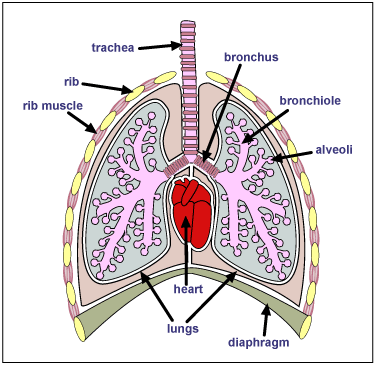
Figure 6.4.1 - The ventilation system
6.4.5 Explain the mechanism of ventilation of the lungs in terms of volume and pressure changes caused by the internal and external intercostal muscles, the diaphragm and abdominal muscles.
Inhalation:
- The external intercostal muscles contract. This moves the ribcage up and out.
- The diaphragm contracts. As it does so it moves down and becomes relatively flat.
- Both of these muscle contractions result in an increase in the volume of the thorax which in turn results in a drop in pressure inside the thorax.
- Pressure eventually drops below atmospheric pressure.
- Air then flow into the lungs from outside the body, through the mouth or nose, trachea, bronchi and bronchioles.
- Air continues to enter the lungs until the pressure inside the lungs rises to the atmospheric pressure.
Exhalation:
- The internal intercostal muscles contract. This moves the ribcage down and in.
- The abdominal muscles contract. This pushes the diaphragm up, back into a dome shape.
- Both of these muscle contractions result in a decrease in the volume of the thorax.
- As a result of the decrease in volume, the pressure inside the thorax increases.
- Eventually the pressure rises above atmospheric pressure.
- Air then flows out of the lungs to outside of the body through the nose or mouth.
- Air continues to flow out of the lungs until the pressure in the lungs has fallen back to atmospheric pressure.